10 Best Linear Motors for Global Buyers
Choosing among the 10 Best Linear Motors for Global Buyers requires more than comparing speed, force, or catalogue prices. Linear motors convert electrical energy directly into motion, removing mechanical transmissions such as belts, gears, and ball screws. This can improve responsiveness, cleanliness, and positioning accuracy in demanding equipment. However, performance depends on the complete system.
Dr. J. F. Gieras, a widely recognized researcher and author in electric machines, has emphasized that “linear motor performance must be evaluated as part of the entire motion system.” That principle guides this overview. A motor that reaches 5 meters per second may still disappoint if its encoder resolution, thermal management, or cable design is unsuitable. Practical experience shows that installation details matter. Very much.
The selected linear motors are considered from a global buyer’s viewpoint. Their evaluation includes continuous force, peak force, stroke length, acceleration, feedback compatibility, cooling requirements, maintenance, and supplier support. Regional voltage standards and replacement-part availability also deserve attention. A factory in Germany may prioritize precision and documentation, while a packaging line in Southeast Asia may focus on uptime and service access.
No ranking can fit every application. That is an important limitation. A compact ironless design may suit semiconductor handling, but it may lack the force needed for heavy automation. An iron-core motor can deliver stronger thrust, yet cogging and heat may require additional control work. Buyers should verify technical claims through application testing, not marketing language alone. This guide offers a careful starting point, while leaving room for better questions and more informed decisions.
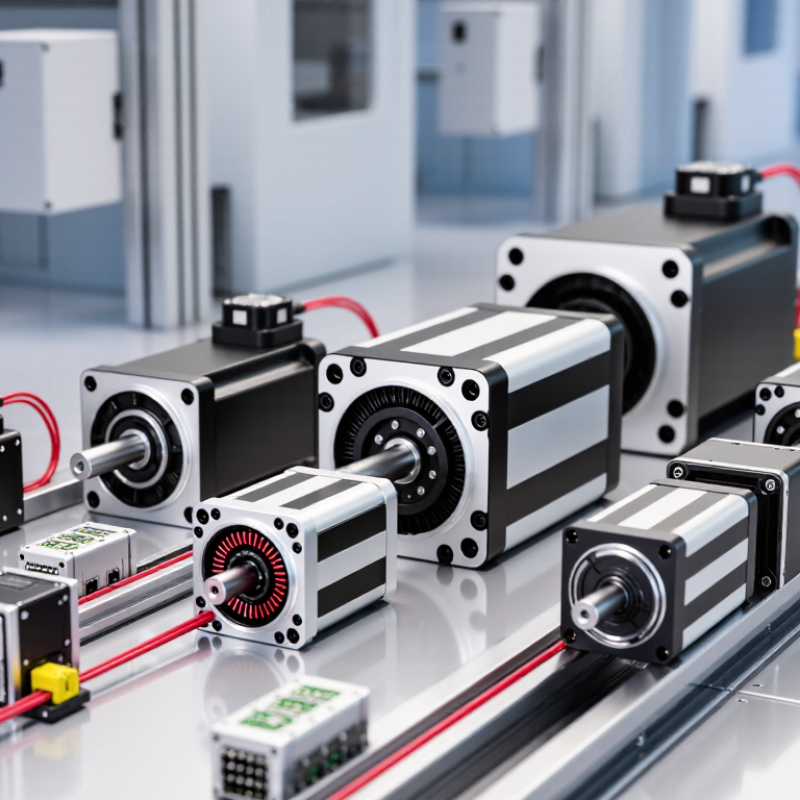
Linear Motors: Definition, Structure, and Operating Principles
Linear motors convert electrical energy directly into linear motion, rather than rotating it through a screw or belt. This direct arrangement can deliver rapid acceleration, accurate positioning, and low mechanical wear. They appear in precision stages, factory handling equipment, inspection tables, and automated doors.
A typical linear motor has three main parts: a stationary magnetic track, a coil assembly, and a guided moving carriage. Permanent magnets are arranged with alternating poles along the track. The coil section contains copper windings, often supported by an iron core. Position sensors report carriage location to a drive controller. Bearings or air guides keep the gap stable. Small gaps matter.
When controlled current enters the windings, it creates a magnetic field. This field interacts with the permanent magnets, producing thrust along the travel axis. Reversing current reverses motion. Increasing current raises force, but also increases heat. Feedback helps the controller correct position errors in real time. In practice, dust, cable flexing, thermal expansion, and uneven mounting can reduce accuracy. The textbook model is not enough. A specification can still hide practical weaknesses. Global buyers should check load, stroke, speed, duty cycle, cooling, electrical requirements, and local service capability. Measurements often reveal what drawings miss.
10 Best Linear Motors for Global Buyers - Linear Motors: Definition, Structure, and Operating Principles
| No. | Linear Motor Type | Operating Principle | Typical Continuous Force | Typical Peak Force | Typical Maximum Speed | Positioning Capability | Recommended Applications |
|---|---|---|---|---|---|---|---|
| 1 | Ironless Permanent-Magnet Linear Motor | A three-phase coil assembly produces a moving magnetic field that interacts with permanent magnets. The ironless design minimizes cogging and attraction force. | 50–1,000 N | 100–2,000 N | 1–5 m/s | Sub-micrometer with a suitable linear encoder | Semiconductor equipment, optical inspection, laboratory stages, precision scanning |
| 2 | Iron-Core Permanent-Magnet Linear Motor | The coil assembly contains an iron core, concentrating magnetic flux and delivering high force density through interaction with a permanent-magnet track. | 500–5,000 N | 1,000–10,000 N | 1–3 m/s | Typically 1–10 µm with feedback control | Machine tools, heavy automation, transport axes, high-force production equipment |
| 3 | Tubular Permanent-Magnet Linear Motor | A cylindrical coil and magnet arrangement generates axial thrust in a compact tube-shaped motor, often with a moving magnet rod. | 20–800 N | 50–1,500 N | 0.5–2 m/s | Typically 1–20 µm with a linear sensor | Pick-and-place systems, compact actuators, medical devices, valve and positioning mechanisms |
| 4 | Voice-Coil Linear Actuator | Current flowing through a coil creates force within a permanent-magnet field. Force is approximately proportional to coil current over its rated stroke. | 1–200 N | 5–500 N | 0.1–2 m/s | Nanometer to micrometer range, depending on feedback and stroke | Camera focusing, speakers, vibration control, lens positioning, short-stroke motion |
| 5 | Flat Linear Induction Motor | A traveling magnetic field induces currents in a conductive reaction plate, producing thrust without permanent magnets on the secondary side. | 100–3,000 N | 200–6,000 N | 1–10 m/s | Typically 10–100 µm with closed-loop feedback | Conveyors, sorting systems, clean manufacturing, long-stroke industrial transport |
| 6 | U-Channel Linear Motor | A forcer moves inside a U-shaped permanent-magnet track, providing compact guidance and reduced magnetic exposure on the outer sides. | 50–1,500 N | 100–3,000 N | 1–4 m/s | Sub-micrometer to a few micrometers with encoder feedback | Electronic assembly, inspection platforms, laboratory automation, compact XY stages |
| 7 | Long-Stroke Linear Motor Stage | A modular motor and extended magnet track create direct linear motion over travel lengths commonly exceeding one meter. | 200–3,000 N | 500–6,000 N | 1–5 m/s | Typically 1–10 µm over long travel | Large-format inspection, robotics, machine tools, packaging and material handling |
| 8 | High-Speed Linear Motor Stage | A low-inertia moving element is driven by a controlled electromagnetic field, prioritizing rapid acceleration, velocity, and settling time. | 100–2,000 N | 300–4,000 N | 3–10 m/s | Typically 1–10 µm with a high-resolution encoder | High-throughput inspection, dispensing, electronics assembly, rapid indexing |
| 9 | Precision Nanopositioning Linear Motor | Direct electromagnetic drive is combined with a high-resolution position sensor, precision guide, and servo controller for very fine motion. | 5–300 N | 10–600 N | 0.05–1 m/s | Nanometer-level commanded resolution; actual accuracy depends on the complete system | Microscopy, photonics, metrology, wafer inspection, precision research equipment |
| 10 | Water-Cooled Linear Motor | Cooling channels remove heat from the coil assembly, allowing higher continuous current and force in demanding duty cycles. | 1,000–10,000 N | 2,000–20,000 N | 0.5–3 m/s | Typically 1–10 µm with a closed-loop linear scale | Heavy machine tools, industrial presses, repetitive high-duty automation, large positioning axes |
Technical note: The values shown are representative selection ranges for commercially available linear-motor systems, not guaranteed ratings for a specific model. Actual force, speed, accuracy, travel, thermal performance, and duty cycle depend on motor dimensions, guide friction, load mass, cooling method, drive current, encoder resolution, and operating conditions.
Related Posts
-

Exploring the Advantages of Direct Drive Linear Motors in Modern Technology?
-
What is a Motion Systems and How Do They Work?
-

Why Choose Linear Motor Drive for Your Automation Needs?
-
What are the Advantages of Direct Drive Linear Motors?
-
Why Do Global Buyers Choose Motion Systems?
-
How to Choose the Best Motion Systems for Your Needs