Exploring the Advantages of Direct Drive Linear Motors in Modern Technology?
The advancement of technology has spurred interest in direct drive linear motors. These motors offer unique advantages over traditional systems. Their design allows for increased efficiency and precision in various applications.
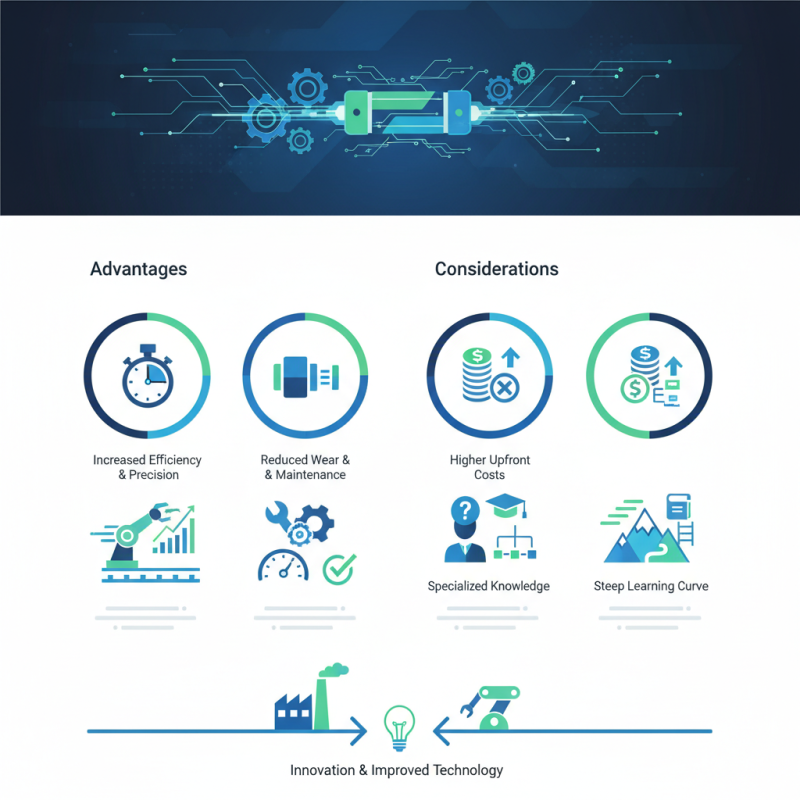
Direct drive linear motors eliminate the need for mechanical linkages. This leads to fewer parts, reducing wear and maintenance costs. The simplicity of their design is appealing to engineers. However, there are challenges such as higher upfront costs and the need for specialized knowledge during installation.
In industries like manufacturing and robotics, direct drive linear motors enhance performance. They provide faster response times and greater accuracy. Yet, some may find them daunting due to the steep learning curve. Overall, exploring the benefits and drawbacks of direct drive linear motors opens doors to innovation and improved technology.
Overview of Direct Drive Linear Motors: Definition and Functionality
Direct drive linear motors represent a significant leap in modern technology. They offer a direct approach to converting electrical energy into linear motion. This system eliminates the need for intermediate mechanical components, like gears or belts. This direct action allows for improved efficiency and precision in various applications. Users experience less backlash and higher accuracy.
Their functionality is built on the principles of electromagnetic forces. In simple terms, electric currents generate magnetic fields. These magnetic fields then create movement along a linear path. This design ensures smooth operation and reduces wear. However, it requires precise control systems to function optimally.
Tip: Always consider the environment where these motors will operate. They perform best in clean, controlled spaces, free from debris.
One challenge is the heat generation during operation. Users need to implement adequate cooling solutions. This point is often overlooked. Without proper heat management, performance may degrade over time.
Tip: Regular maintenance checks can prevent unforeseen issues. Identifying potential problems early is key to longevity.
Exploring the Advantages of Direct Drive Linear Motors in Modern Technology
| Feature |
Advantage |
Application Areas |
| High Precision |
Enhanced positioning accuracy and repeatability. |
Robotics, CNC machining, and semiconductor manufacturing. |
| High Speed |
Rapid acceleration and deceleration capabilities. |
Automated assembly lines, packaging machinery. |
| Low Maintenance |
Fewer moving parts leading to reduced wear and tear. |
Industrial machinery, aerospace components. |
| Energy Efficiency |
Lower power consumption compared to traditional systems. |
Electric vehicles, renewable energy systems. |
| Compact Design |
Space-saving solutions with integrated motion drives. |
Medical devices, small-scale manufacturing. |
Key Advantages of Direct Drive Linear Motors in Industrial Applications
Direct drive linear motors (DDLMs) are increasingly finding their place in various industrial applications. These motors offer significant advantages, such as high precision, faster response times, and reduced maintenance needs. According to a report by Markets and Markets, the direct drive motor market is projected to grow from $5.2 billion in 2020 to $9.3 billion by 2025, reflecting a strong trend toward their adoption in manufacturing.
One key advantage of DDLMs is their ability to provide a smooth and consistent motion. This leads to enhanced accuracy in operations like cutting and positioning. Conventional motors often suffer from backlash, which can hinder performance. However, DDLMs eliminate mechanical components, such as gears and belts, reducing wear and tear.
Tip: Regularly monitor the alignment and installation of DDLMs. Misalignment can lead to performance issues over time.
Another important aspect is energy efficiency. DDLMs consume less power compared to traditional motor systems. They convert electrical energy directly into motion without intermediary mechanical components. Reports suggest that energy savings can be up to 30% when using direct drive systems. This not only lowers operational costs but also minimizes the carbon footprint of manufacturing processes.
Tip: Conduct periodic energy audits to assess the efficiency of your motors. This can yield insights for further improvements.
Comparison of Direct Drive Linear Motors and Traditional Motor Systems
When comparing Direct Drive Linear Motors (DDLMs) to traditional motor systems, the differences are stark. DDLMs operate without the need for gears or belts, which simplifies the design. This reduction in mechanical parts leads to lower maintenance costs. According to a report by the International Journal of Engineering Research, systems using DDLMs can have power efficiency improvements of up to 30% compared to their traditional counterparts.
Performance is another area where DDLMs excel. They can achieve high speeds and precise positioning. A study from the Institute of Electrical and Electronics Engineers notes that DDLMs can provide motion resolution of less than 1 micron. This level of precision is difficult for traditional systems to match. However, initial costs for DDLMs can be higher, which makes some manufacturers hesitant.
Reliability is a significant concern in modern tech. DDLMs have fewer mechanically moving parts, which typically results in extended lifespans. However, the technology is not without flaws. Issues like heat generation and control complexity need consideration. Investment in DDLMs offers many benefits, but it requires careful evaluation of long-term operational costs versus initial investment.
Impact of Direct Drive Linear Motors on Energy Efficiency and Sustainability
Direct drive linear motors (DDLMs) are gaining traction in various industries due to their remarkable energy efficiency. Unlike traditional systems, DDLMs eliminate the need for gearboxes and mechanical linkages. This reduction in mechanical components translates into fewer energy losses. Reports indicate that DDLMs can improve system efficiency by up to 30%. This boost is significant in an era where energy costs are escalating, and energy efficiency standards are tightening.
The impact on sustainability is profound. With less energy wasted, the environment benefits from reduced carbon emissions. The International Energy Agency notes that adopting advanced motor technologies can result in a decrease of 2.4 gigatonnes of CO2 emissions annually worldwide. However, transitioning to DDLMs also presents challenges. The initial investment can be substantial, which might deter some companies. There’s also the need for skilled technicians who understand these advanced systems.
Despite these hurdles, the long-term operational savings and environmental benefits make DDLMs an attractive option. Stakeholders must navigate these issues carefully. Continuous research and development efforts could yield solutions that enhance not only performance but also accessibility. Moving forward, the industry must focus on education and resource allocation to fully unleash the potential of direct drive linear motors.
Exploring the Advantages of Direct Drive Linear Motors in Modern Technology
This chart illustrates the impact of Direct Drive Linear Motors on energy efficiency across various industries. The data reflects the percentage improvement in energy savings compared to traditional motor systems.
Future Trends and Innovations in Direct Drive Linear Motor Technology
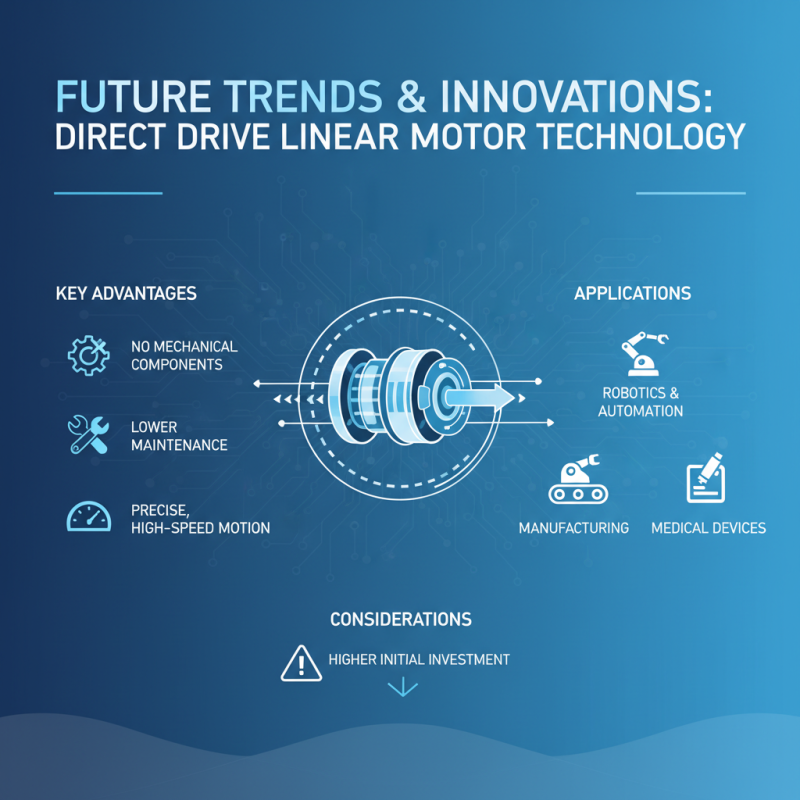
Direct drive linear motors are gaining traction in various sectors. Their ability to provide precise motion is revolutionizing automation and robotics. These motors eliminate mechanical components, leading to lower maintenance needs. They offer a smooth operation suitable for high-speed applications. However, the initial investment can be high and might deter some users.
Future trends indicate a push towards miniaturization of these motors. Smaller systems could enable new applications in medical devices and consumer electronics. Innovations in materials may enhance efficiency and reduce power consumption. Industry experts visualize a blend of AI with linear motor technology for smarter solutions. Yet, questions remain about scalability in larger systems and their environmental impact.
Research is ongoing to address these challenges. As the technology evolves, it may become more accessible. Not all applications may benefit equally, and some areas require thorough exploration. Balancing performance and cost will be crucial for widespread adoption.