What Is a Torque Motor and How Does It Work?

What Is a Torque Motor and How Does It Work?

Torque motors are built for direct-drive motion. They produce rotational force without needing a traditional gearbox. This design can simplify machines, reduce backlash, and improve positioning accuracy.

As motion-control engineer Dr. Kevin Craig explains, “A torque motor turns the load itself into part of the motor.” This idea is central to understanding torque motors. The motor’s rotor connects directly to the moving assembly. Its stator remains fixed around it. When controlled electrical current passes through the windings, a magnetic field develops. That field pushes the permanent magnets around the rotor. The result is smooth, controlled torque.

Picture a rotary table carrying a heavy metal component. A conventional motor may require several gears to move it. A torque motor can drive the table directly. Fewer mechanical parts can mean less maintenance. It can also reduce vibration and mechanical noise.

The concept is powerful. It is not automatically the best choice.

Torque motors often require careful thermal management. Their large diameter may also demand more installation space. Engineers must examine continuous torque, peak torque, speed, cooling, feedback, and load inertia. A motor that performs well in a laboratory may behave differently inside a sealed production machine.

This guide explains torque motors in practical terms. It explores their construction, operating principle, benefits, limitations, and common applications. Some explanations may appear simple. Real systems are rarely simple. That is worth remembering.
What Is a Torque Motor and How Does It Work?

Torque Motor: Definition and Core Purpose

A torque motor is a rotary electric motor designed to produce high torque at low speed. Unlike conventional motors, it often drives the load directly, without a gearbox. Its core purpose is precise rotation, not simply rapid movement. The motor’s permanent magnets create a magnetic field, while controlled current in the stator produces torque. A position sensor then reports the rotor angle, allowing the drive system to adjust current within milliseconds.

The practical benefit is clear. Fewer mechanical parts can reduce backlash, noise, and maintenance. This matters in robotic joints, semiconductor equipment, machine tools, and large positioning tables. The International Energy Agency reported that electric motor systems use more than 40% of global electricity. Better control therefore has significant efficiency value, even when the motor itself seems compact. It also requires careful sizing.

A torque motor must match continuous torque, peak torque, speed, thermal limits, and load inertia. A larger frame is not automatically better. Excess torque can increase heat, cost, and control difficulty. In my experience, engineers sometimes focus on peak performance and underestimate continuous heating. That assumption can be wrong. The U.S. Department of Energy’s Motor Systems Market Assessment emphasizes that system-level efficiency depends on the motor, drive, load, and operating profile together. Therefore, the motor’s real purpose is stable, measurable torque under actual working conditions, not impressive laboratory figures.

Key Components of a Torque Motor

What Is a Torque Motor and How Does It Work?

Key Components of a Torque Motor

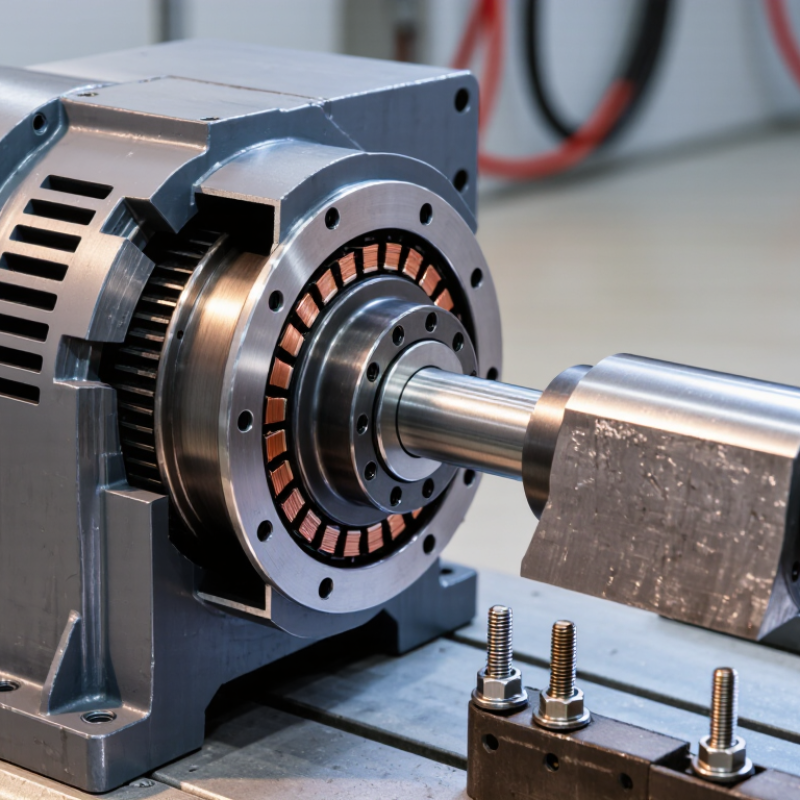
A torque motor is a direct-drive electric motor built for high torque at low speed. It removes the gearbox, reducing backlash and mechanical noise. The stator contains copper windings fixed inside the housing. When current passes through these windings, it creates a rotating magnetic field. The rotor responds through permanent magnets or electromagnetic poles. This produces smooth rotational force around the shaft.

The rotor, stator, bearings, encoder, housing, and drive form the working system. Bearings support the rotor and control radial movement. An encoder reports position and speed to the controller. The controller adjusts phase current within milliseconds. Some designs add water channels or fins around the stator. This matters because heat lowers magnetic strength and shortens insulation life. Small details matter.

The International Energy Agency reports that electric motor systems consume about 50% of global electricity. Efficiency is therefore more than a design preference. The International Federation of Robotics recorded 541,302 industrial robot installations worldwide in 2023. Many robotic joints use direct-drive or low-backlash motor systems. These figures show why compact torque production matters in automation.

A practical warning remains. A larger motor is not always better. Continuous torque, peak torque, thermal limits, encoder accuracy, and bearing load must match the application. I have seen specifications emphasize peak torque while hiding the short duty cycle. That can mislead engineers. A torque motor may appear powerful on paper, yet overheat during repeated acceleration. Careful testing under real loads remains essential.

How a Torque Motor Produces Continuous Torque

A torque motor is a large-diameter, low-speed motor designed to deliver force continuously. Unlike a conventional motor with reduction gears, it can drive a load directly. Its rotor uses permanent magnets, while the stator carries controlled current. The magnetic fields interact and create turning force. More current usually produces more torque. The simple explanation is useful, but incomplete.

Continuous torque depends mainly on heat removal. Copper losses rise with the square of current, so temperature can limit operation before magnetic force does. A larger diameter improves torque production because force acts farther from the shaft center. Position feedback also helps the controller maintain smooth torque at very low speeds. IEC 60034-1 distinguishes operating duties and thermal limits, which engineers must check before selecting a motor. The International Energy Agency reports that electric motor systems consume roughly half of global electricity. Efficient direct-drive motion therefore has practical energy value, not only technical appeal. The U.S. Department of Energy also identifies motor systems as a major share of industrial electricity use.

Tips: Check continuous torque, peak torque, speed, and winding temperature separately. Do not size the motor from peak torque alone. Measure the real load cycle. A motor may survive a short overload but overheat during a slow, heavy movement. This is where many calculations become less certain. Cooling, mounting stiffness, cable losses, and feedback tuning can change the result. A torque motor is powerful, but it is not automatically efficient in every machine.

What Is a Torque Motor and How Does It Work? – How a Torque Motor Produces Continuous Torque

Data Dimension Technical Data How It Relates to Continuous Torque
Motor Definition A torque motor is a direct-drive electric motor designed to generate high torque at low or zero speed. It can drive a load without a gearbox, reducing backlash, mechanical wear, and transmission losses.
Typical Motor Construction Usually a brushless permanent-magnet synchronous motor with a large diameter and short axial length. The larger effective radius increases torque for a given tangential electromagnetic force.
Torque Equation T = kt × I, where T is torque, kt is the torque constant, and I is motor current. Within the rated operating region, increasing phase current increases electromagnetic torque approximately linearly.
Torque Constant kt is commonly expressed in N·m/A and is related to the motor's electromagnetic design. A higher torque constant allows the motor to produce more torque for the same current.
Continuous Torque Torque that can be maintained indefinitely under specified electrical, thermal, and cooling conditions. The continuous rating is limited mainly by allowable winding temperature and heat dissipation, not only by magnetic strength.
Zero-Speed Operation The motor can produce holding torque at 0 rpm when controlled current is maintained. Because there is no rotational airflow at standstill, liquid cooling or conduction through the housing may be required for sustained torque.
Electrical Input A servo drive supplies controlled three-phase currents with the correct amplitude, frequency, and phase angle. Closed-loop current control regulates torque and helps keep the motor within its continuous thermal limit.
Position Feedback An encoder or resolver measures rotor position and speed for electronic commutation and servo control. Accurate feedback allows stable torque production at low speed and during stationary load holding.
Power Relationship P = T × ω, where P is mechanical power in watts and ω is angular speed in rad/s. At zero speed, mechanical output power is zero even though the motor may produce substantial static torque.
Example Power Calculation A motor producing 10 N·m at 100 rpm delivers approximately 104.7 W of mechanical power. The calculation is: 10 × 2π × 100 ÷ 60 = 104.7 W.
Copper Loss Ploss = I²R, where I is current and R is winding resistance. Heat rises rapidly as current increases, which is why continuous torque is normally lower than short-duration peak torque.
Peak Torque A higher torque level available for a limited period, subject to current, demagnetization, mechanical, and thermal limits. Peak torque supports acceleration or brief overloads but should not be treated as the continuous operating rating.
Speed-Torque Behavior The motor generally operates in a constant-torque region up to a base speed, followed by a reduced-torque field-weakening region. Available torque decreases at higher speeds because the back electromotive force approaches the drive's voltage limit.
Cooling Methods Natural conduction, forced air, or liquid cooling may be used depending on the required continuous torque and installation environment. Improved heat removal permits higher continuous current and therefore higher continuous torque.
Key Advantages High torque density, low-speed precision, direct coupling, low mechanical compliance, and high positioning accuracy. These characteristics make torque motors suitable for rotary tables, robotic joints, indexing systems, and precision motion equipment.
Important Design Limitation The continuous torque rating depends on winding temperature, ambient temperature, mounting structure, cooling method, drive current, and duty cycle. A torque motor should be selected using the complete thermal and motion profile rather than torque alone.
Unit references: 1 N·m ≈ 0.7376 lbf·ft; 1 rad/s ≈ 9.549 rpm. Actual ratings vary with motor construction, controller settings, mounting conditions, and cooling configuration.

Control Methods and Operating Characteristics

A torque motor is a brushless motor designed to produce high torque at low speed. Unlike a conventional motor, it can drive a load directly, without a gearbox. This reduces backlash, noise, and mechanical wear. The rotor turns slowly but strongly. That matters.

Control methods determine how smoothly the motor behaves. Closed-loop control uses an encoder or resolver to compare commanded position with actual movement. The controller then adjusts current within milliseconds. Current mainly controls torque, while voltage influences speed. Servo tuning must balance response, stability, and friction. Excessive gain may create vibration near the stopping point.

Direct torque control can react quickly to load changes, but it demands accurate position feedback. Sinusoidal current control usually produces quieter operation and steadier rotation. In a real machine, cable resistance, bearing drag, and changing temperature affect performance. Heat changes everything. Continuous torque ratings are therefore more useful than short peak ratings during equipment selection.

During commissioning, technicians often check zero position, acceleration, and holding torque separately. A motor may reach the target quickly yet overshoot under a heavy fixture. That result suggests poor tuning, insufficient feedback resolution, or an underestimated load inertia. I have found that reducing speed alone can hide the problem rather than solve it. Better results come from measuring current, temperature, and settling time under the actual working load. Even then, the best setting may change after several hours of operation.

How it works: A torque motor is a brushless permanent-magnet motor designed to produce high torque at low speed, often without a gearbox. In the constant-torque region, current is regulated to control torque; above the base speed, voltage limits cause torque to decrease as speed rises.

Types, Applications, Advantages, and Limitations

What Is a Torque Motor and How Does It Work?

A torque motor is a low-speed, high-torque electric motor that drives a load directly. It removes gears, belts, and many mechanical transmission parts. The rotor turns inside a magnetic field created by the stator. Electronic control adjusts current, position, and speed with precise feedback. This design can produce strong rotary force without demanding high rotational speed. In practical systems, frameless motors are built into a machine, while housed motors arrive as complete assemblies.

Common types include permanent-magnet brushless motors, brushed DC motors, and synchronous reluctance designs. Air-cooled models suit moderate duty cycles and simpler equipment. Water-cooled versions handle greater continuous heat loads. Torque motors appear in robotic joints, CNC rotary tables, inspection equipment, medical mechanisms, and precision positioning stages. They also support gimbals and automated assembly tools. Control matters. An encoder usually reports shaft position, helping the drive maintain accurate motion.

Direct drive offers high stiffness, low backlash, quiet operation, and fewer wearing parts. It can improve accuracy when repeated movement must stop within a narrow tolerance. However, the motor can be expensive and physically wide. Heat becomes difficult to remove during continuous high-torque operation. Peak torque may look impressive, but continuous torque is often the more useful figure. Large rotor inertia can also slow response. A neat specification sheet can still mislead. Real performance depends on cooling, bearings, tuning, load alignment, and duty cycle. Heat remains the catch.