Why Choose Torque Motors for Your Next Project?
When considering the best solutions for your next project, torque motors stand out as a reliable choice. These motors specialize in delivering high torque at low speeds, making them ideal for various applications. Their unique design enhances efficiency and durability, which is crucial for demanding environments.
Industries such as automation, robotics, and electric vehicles increasingly rely on torque motors. Their ability to handle heavy loads and provide precise control can significantly boost project outcomes. Yet, selecting the right torque motor requires careful consideration. Different projects may demand specific performance characteristics, and a one-size-fits-all approach is not always effective.
Furthermore, while torque motors offer numerous benefits, they are not without limitations. It's essential to weigh these against project requirements. In-depth knowledge and experience are crucial for making informed decisions. Understanding the trade-offs can lead to better performance and longer lifespan, ensuring your project is a success.

Benefits of Torque Motors in Modern Applications
Torque motors are becoming the go-to solution in various modern applications. These motors shine in their efficiency and torque density, making them vital for industries like robotics and electric vehicles. A recent industry report indicated that the demand for torque motors is projected to grow at a CAGR of over 8% through 2027. This growth highlights their increasing significance in high-performance applications.
One of the primary benefits of torque motors is their direct drive capability. This feature enables precise control, resulting in improved accuracy. For example, a torque motor can achieve a resolution of up to 0.01 degrees, ideal for robotic arms in manufacturing. Moreover, torque motors have fewer mechanical components, reducing wear and tear. This longevity can lead to lower maintenance costs, contributing to overall project efficiency. However, understanding the specific requirements of your project is vital.
Tip: Always consider your application’s power and torque requirements before selecting a torque motor. A mismatch can lead to inefficiencies and increased operational costs. Another point worth reflecting on is the initial investment; while torque motors are efficient, their upfront cost may be higher than traditional motors. Analyzing the long-term benefits versus the initial expense can prevent financial miscalculations.
Understanding the Mechanics of Torque Motors
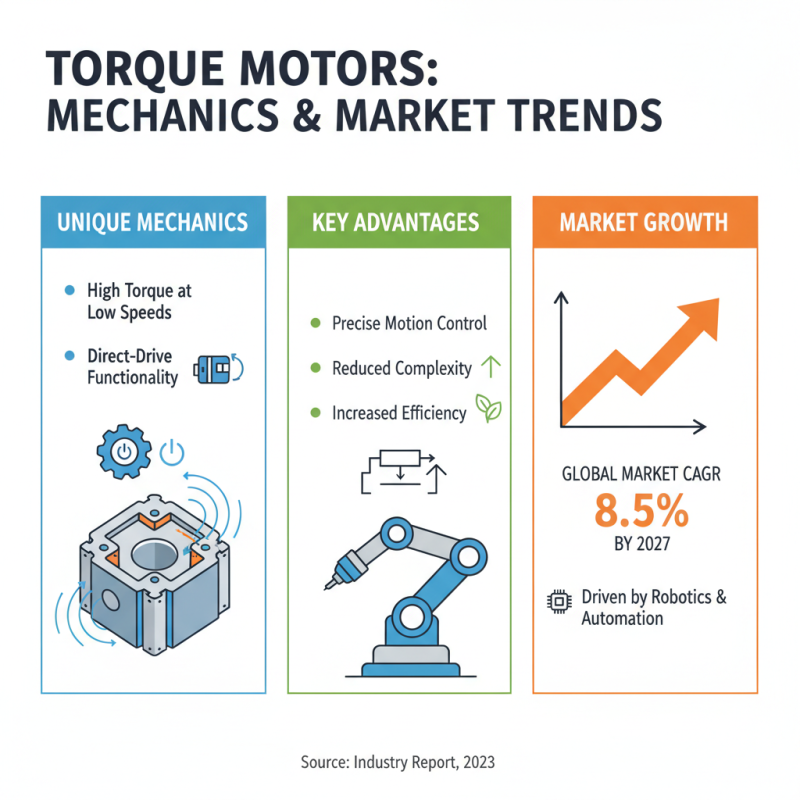
Torque motors are increasingly favored in various applications due to their unique mechanics. These motors excel in delivering high torque at low speeds and are capable of direct-drive functionality. According to a recent industry report, the global torque motor market is projected to grow at a compound annual growth rate (CAGR) of 8.5% by 2027. This rise is fueled by the demand for precise motion control in robotics and automated systems.
Understanding the mechanics behind torque motors reveals their advantages. They utilize magnetic fields to generate torque directly, eliminating the need for gear systems. This can result in greater efficiency and reduced wear over time. A study from the Institute of Electrical and Electronics Engineers (IEEE) highlighted that systems using torque motors can show energy savings of up to 30% compared to traditional motors. However, such systems can be complex to integrate, requiring careful design to avoid costly errors.
Despite their benefits, there are challenges to consider. Torque motors can be sensitive to heat, which may affect performance. They also may require specific controllers, adding to system complexity. A comprehensive approach ensures these motors serve efficiently while addressing potential pitfalls. Familiarity with the mechanics of torque motors can lead to better project outcomes and innovative solutions.
Comparative Advantages of Torque Motors Over Other Motor Types
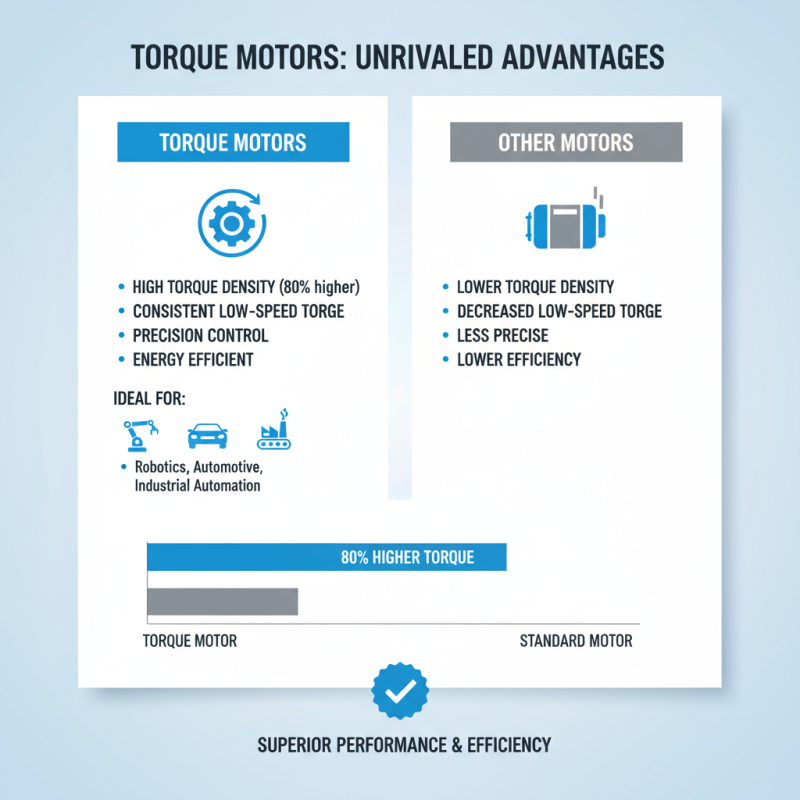
Torque motors offer distinct advantages compared to traditional motor types. They excel in high torque applications and often maintain consistent torque at low speeds. This feature is critical in industries like robotics and automotive, where precision matters. According to industry reports, torque motors can provide up to 80% higher torque density than standard electric motors. This efficiency translates to better performance and less energy consumption.
When selecting motors for a project, consider the application specifics. Torque motors are particularly suitable for linear and rotary motions. Their design allows for high responsiveness, crucial in scenarios that require quick adjustments. One report noted that companies using torque motors reported a 30% improvement in cycle times. This enhancement not only boosts productivity but can also reduce operational costs.
Tips for implementation: Always assess the operating environment. Torque motors may require additional cooling in high-temperature settings. Additionally, regular maintenance ensures optimal performance. Periodically checking alignment and wear can prevent costly downtime. Embracing these practices can lead to a more reliable production process. Reflect on the specific needs of your project. Finding the right balance between cost and performance is key.
Key Considerations When Choosing a Torque Motor
When selecting a torque motor, consider power requirements. Assess the specific torque output needed for your application. A mismatch can lead to inefficiencies. Too little torque might underperform, while excessive power could waste energy. It’s vital to find the right balance.
Efficiency and heat generation are crucial aspects. High-performance torque motors tend to generate heat, impacting their lifespan. Look for motors with good thermal management features. This would enhance reliability over time. Consider how long the motor will run daily. Continuous operation can escalate wear.
Installation and maintenance must not be overlooked. Some torque motors require special setups, impacting overall costs. Understanding accessibility for maintenance is also essential. Regular checks will prevent potential failures. All factors combined influence your project’s success. Be aware, even small decisions matter greatly.
Applications and Industries Leveraging Torque Motors for Success
Torque motors are gaining traction across various sectors. Their design allows for high efficiency and precise control. These benefits make them ideal for applications requiring fine-tuned performance.
In the automotive industry, torque motors facilitate advanced electric vehicle technologies. They enhance acceleration and braking systems, improving overall vehicle safety. Manufacturing environments also benefit from these motors. Automation processes depend on their reliability for tasks like assembly and robotics.
Healthcare is another field reaping the rewards of torque motors. Medical devices often require precise movements, and torque motors deliver that with exceptional accuracy. However, users must reflect on their specific needs and potential limitations of torque motors. Their unique characteristics might not fit every project. Balancing efficiency with specific application requirements is vital.