China Best ETEL Linear Motor Supplier for Global Buyers
China Best ETEL Linear Motor Supplier for Global Buyers
Selecting a reliable etel linear motor supplier requires more than comparing catalog prices. Buyers need evidence of engineering experience, manufacturing consistency, and responsive technical support. In precision equipment, a few microns can affect wafer placement, lens alignment, or inspection results. The supplier’s real value appears during integration, not only during quotation.
Dr. Thomas A. Lipo, a respected motor-design researcher, offers a practical principle: “Motor performance must be judged within the complete motion system.” This view matters when evaluating an etel linear motor from China. A capable supplier should explain force ratings, continuous duty limits, encoder compatibility, thermal behavior, and achievable accuracy. They should also provide dimensional drawings, test data, sample validation, and clear warranty terms. Claims without measurable evidence deserve careful review.
China offers strong manufacturing capacity, but quality is not automatically uniform. Some factories provide excellent machining and assembly. Others may overlook cable routing, cooling, or long-term repeatability. That difference matters. Buyers should inspect production controls, incoming-material checks, calibration records, and after-sales procedures. Factory videos help, but independent testing is stronger.
This guide examines how global buyers can compare China-based suppliers of etel linear motor systems. It considers technical support, customization, lead time, documentation, and lifecycle reliability. The evaluation is practical, not idealized. No supplier is perfect. A thoughtful buyer should still request samples, verify specifications, and test performance under real operating conditions before placing a large order.
ETEL Linear Motors: Technology, Design, and Industrial Applications
ETEL linear motors use electromagnetic force to create direct, contactless motion. They remove ballscrews, gears, and related transmission backlash. A typical design combines a magnetic track, three-phase coil assembly, linear encoder, and precision controller. This architecture supports high acceleration and smooth positioning. However, it also exposes thermal and installation weaknesses. Poor cable routing or uneven mounting can reduce accuracy quickly.
Industrial demand is rising around precision automation. The International Federation of Robotics reported 541,302 industrial robot installations worldwide in 2023. Many robot cells now require faster indexing and tighter repeatability. ETEL linear motors suit semiconductor stages, laser processing, electronics inspection, and medical equipment. SEMI’s World Fab Forecast expects semiconductor manufacturing equipment spending to reach about 112 billion dollars in 2025. That expansion increases demand for clean, compact motion platforms.
Design choices still require practical testing. Peak force is not continuous force. Cooling matters. Encoder resolution alone cannot guarantee machine accuracy. Engineers should measure settling time, vibration, thermal drift, and payload changes under real operating cycles. In my experience, a laboratory result can look impressive but fail after several hours of production. The U.S. Department of Energy also identifies motor-driven systems as major industrial electricity users, making efficiency and regenerative control important. A supplier should therefore provide measured curves, environmental limits, service data, and application references, not only attractive specifications.
Linear Motor Technology, Design, and Industrial Applications
Linear motors provide direct-motion performance without mechanical transmission components such as lead screws or belts. Their continuous and peak force requirements vary significantly by application, from precision positioning to heavy industrial automation.
The values shown are representative engineering reference points in newtons, intended for technology comparison rather than manufacturer-specific specifications. Peak force is typically used for acceleration, disturbance rejection, and short-duration overload conditions.
Why China Is a Leading Source of ETEL Linear Motor Solutions
China is a leading source of ETEL linear motor solutions because its automation ecosystem is broad and highly responsive. The country combines precision machining, magnet production, motion-control engineering, and rapid component sourcing. These capabilities can shorten development cycles for semiconductor, electronics, packaging, and laboratory equipment.
The demand is measurable. According to the International Federation of Robotics’ World Robotics 2024 report, China installed 276,288 industrial robots in 2023. That represented more than half of global installations, which reached 541,302 units. This installed base creates practical experience with high-speed positioning, repeatability, thermal control, and continuous operation. MarketsandMarkets’ linear motor research also forecasts sustained market growth through 2028, supported by automation and semiconductor investment. Still, supplier selection should not depend on forecasts alone. A lower quotation may hide weaker feedback tuning, inconsistent magnet quality, or limited technical support. No supplier is perfect.
Tips: Request acceleration curves, positioning accuracy data, thermal test results, and sample-run records. Check the motor under your real payload, stroke, duty cycle, and ambient temperature. Ask for traceable inspection documents, not attractive claims. One overlooked detail matters: cable routing can affect vibration and service life. China offers strong value, but engineering verification remains essential.
Key Criteria for Selecting a Reliable Chinese ETEL Supplier
Choosing a reliable Chinese linear motor supplier requires more than comparing unit prices. Experienced buyers inspect manufacturing records, inspection methods, and technical communication before placing a large order. Request drawings, material specifications, force data, encoder options, and thermal performance results. These documents reveal whether the supplier understands motion control or simply resells standard components.
Ask for a sample motor and test it under realistic conditions. Check positioning accuracy, repeatability, force ripple, noise, and heat rise after several operating hours. A trustworthy factory should provide serial-number traceability and calibration records. Factory videos are useful, but an on-site audit or independent inspection offers stronger evidence. Small warning signs matter. Slow replies, unclear tolerances, and changing specifications can create expensive integration problems. Confirm production capacity, spare-part availability, packaging methods, and delivery controls in writing. The supplier should also explain how engineers handle design changes and unexpected failures. That response often matters more than a polished website.
No supplier is perfect. Even a capable manufacturer may miss a schedule or misunderstand a tolerance. Reliable partners acknowledge problems quickly and propose measurable corrective actions. Ask for references from comparable automation projects, while checking whether those references are genuine and recent. A practical evaluation may include a pilot order, incoming inspection, and a review of long-term support. This approach takes more time, but it reduces the risk of unstable performance, costly rework, and production delays.
Manufacturing Quality, Customization, and Testing Standards
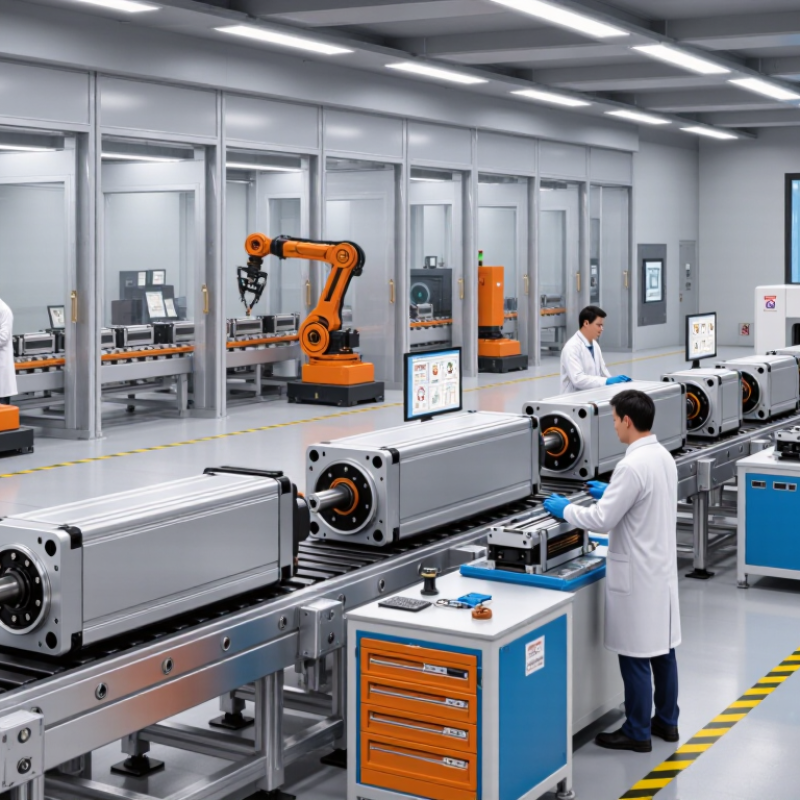
For global buyers, a reliable linear motor supplier must prove quality through repeatable manufacturing, not attractive specifications alone. Experienced production teams control winding, magnet assembly, machining, and cable routing at every stage. Each motor receives a serial number, material record, and inspection report. These details help engineers trace problems quickly.
Customization should begin with the application. Stroke length, force, speed, encoder resolution, mounting holes, and cooling options can be adjusted for different machines. Our engineers review load profiles and duty cycles before confirming a design. A small change in acceleration may affect heat, vibration, and service life. That conversation prevents costly revisions later.
Testing must reflect real operating conditions. Suppliers should measure thrust, positioning accuracy, insulation resistance, temperature rise, noise, and vibration. Extended running tests can reveal thermal drift that short checks miss. Quality teams should compare results with approved drawings and customer specifications. Records must remain clear and accessible.
The process is not flawless. That admission matters. Occasional deviations can occur during assembly or transport. Reliable factories isolate nonconforming units, investigate root causes, and document corrective actions. Internal procedures aligned with recognized quality systems support consistent production. However, certificates alone cannot replace physical evidence. Sample reports, calibration records, and factory communication deserve equal attention. Global buyers gain confidence when every tested motor matches its documented performance.
Global Buying, Export Support, and After-Sales Service Considerations
For global buyers, selecting a Chinese linear motor supplier requires more than comparing unit prices.
Export experience should be visible in practical details, including commercial invoices, packing lists, certificates, and accurate HS code guidance. A capable supplier confirms voltage, stroke, load, encoder type, and installation conditions before production begins. These checks reduce delays at customs and prevent costly specification changes.
Packaging also deserves close attention.
Motors should arrive in moisture-resistant protection, with fixed moving parts and clear labels. Export teams should provide tracking updates, shipping documents, and realistic delivery dates. They should also explain Incoterms in plain language.
A short video inspection before shipment can reveal loose connectors or damaged cable outlets. It is a small step, but it builds confidence.
After-sales support is where many purchasing decisions become difficult.
Ask about commissioning help, response times, spare parts, and warranty procedures. Remote troubleshooting may include wiring diagrams, parameter files, and live video guidance. For larger systems, a service engineer or trained local partner can reduce downtime.
No supplier gets every shipment perfect. A missed connector or unclear manual can still happen. What matters is whether the team records the issue, accepts responsibility, and improves the process. Buyers should keep installation photos, operating data, and maintenance records. Clear evidence helps both sides solve problems faster and refine future orders.