Choosing the 2026 best linear motor controller is not a hunt for the biggest speed rating. Global buyers need to match controller performance to the motor, load, feedback system, and operating environment. A mismatch can show up as a fine vibration on the carriage, excess heat in the cabinet, or positioning errors during rapid starts and stops. Small details matter.
Peter Nachtwey, a motion-control engineer known for his work with control systems, offers a useful perspective. A practical paraphrase of that engineering approach is: “Repeatable motion matters more than an impressive specification sheet.” This is a paraphrase, not a verified verbatim quotation. Buyers should still confirm every performance claim against a datasheet and application test. A test under real load can reveal limits that a catalog does not.
This guide compares controller features that affect real projects: continuous and peak current, encoder compatibility, tuning tools, communication interfaces, safety functions, and vendor support. It also considers integration needs, from compact packaging equipment to precision inspection stages. Not every product will suit every machine. Some specifications are easy to compare; long-term service access is harder. That deserves a closer look.
For international procurement teams, documentation quality and responsive technical support can matter as much as raw performance. Check voltage options, environmental ratings, replacement availability, and commissioning guidance before placing an order. Ask suppliers to explain how their linear motor controller handles acceleration, thermal limits, and fault recovery. Then compare the answers—not just the brochures. A little skepticism helps.
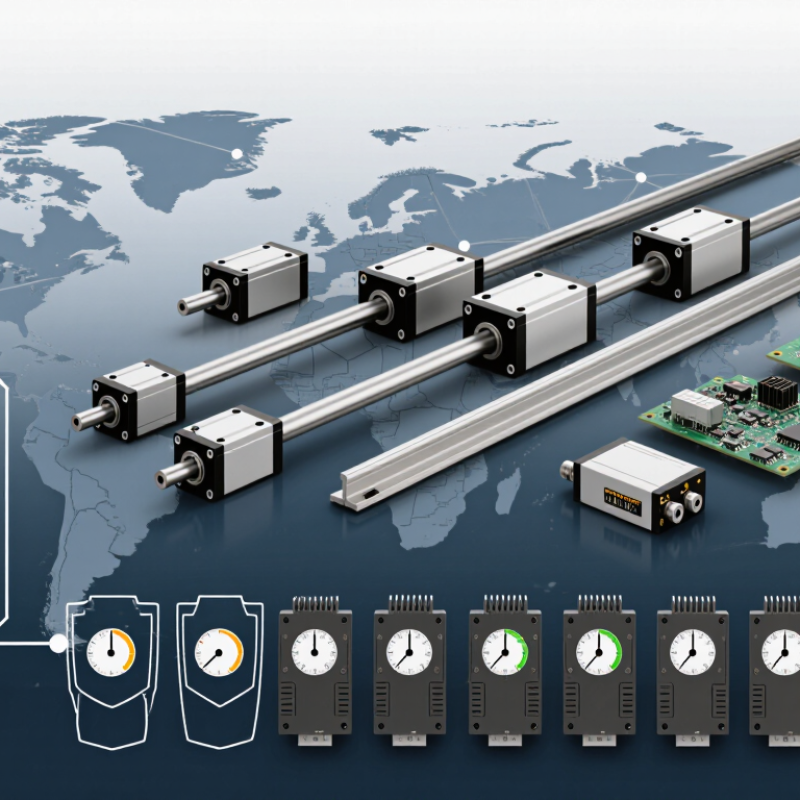
A linear motor controller turns a motion command into controlled electrical current. It drives the motor’s coils in sequence, creating a magnetic force that moves the carriage along a straight path. Unlike a rotary motor system, it does not need a screw or belt to convert rotation into linear travel. That sounds simple. In practice, the controller also manages speed, position, acceleration, and current limits. When an encoder or other feedback device is connected, it compares actual movement with the target and adjusts output. The exact setup depends on the motor design, feedback type, load, and required travel speed.
Tips: Check that the controller supports your motor’s electrical specifications and feedback device. Confirm the required supply voltage, peak current, and communication interface. Leave room for heat to escape. A controller that looks suitable on paper may still need careful tuning.
For global buyers, clear documentation matters as much as headline performance. Look for wiring diagrams, fault codes, and configuration instructions that your engineering team can understand. Ask how the system behaves during overloads or loss of feedback. These details help with commissioning and maintenance across different sites. A small mismatch in encoder settings can cause uneven motion, even when the motor and controller are otherwise compatible. I have seen specifications appear complete while leaving tuning steps unclear; that part deserves a closer review.
A linear motor controller turns a motion profile into timed electrical commands. It coordinates the drive, motor, and position feedback, keeping acceleration and position aligned across each move. On a packaging line, that may mean matching a moving carriage to a product while a camera checks its position.
Small errors matter.
The International Federation of Robotics reported 541,302 industrial robot installations worldwide in 2023 in World Robotics 2024. This figure does not measure linear motor controllers, but it shows the scale of automated motion that control systems must support. In multi-axis equipment, controllers synchronize commands, read encoder feedback, and correct position differences. Network delay, poor tuning, or a loose coupling can still cause vibration. A controller cannot fix every mechanical problem.
Tips: Check encoder resolution, network update time, and support for coordinated axes before selecting a controller. Test the full travel range under the real payload, not just at low speed. Record following error and temperature; the first test may expose assumptions worth revisiting.
A linear motor controller should be compared by the motion it can sustain, not by peak speed alone. The International Federation of Robotics reported 541,302 industrial robot installations worldwide in 2023, up 4% year over year, in World Robotics 2024. That scale of automation makes repeatable motion and serviceability practical buying concerns. Check continuous and peak current, bus voltage, encoder compatibility, and supported feedback resolution. Peak current may look impressive on a datasheet, but continuous current matters during repeated moves.
Measure settling time, following error, and repeatability under the intended load. ISO 230-2:2014 describes methods for testing positioning accuracy and repeatability on numerically controlled axes; it also reminds buyers that test setup affects results. Ask suppliers for test conditions, not just headline figures. A small payload on a cool bench is not your production line. Real machines are less tidy.
Review communication options, synchronization, safety functions, and tuning tools against the existing motion system. Confirm how the controller handles heat, dust, and long duty cycles, and whether replacement units can be configured without lengthy downtime. Request traces from acceleration, reversal, and stop tests. Small details matter. One caveat: published performance figures are difficult to compare when manufacturers use different loads, travel distances, or measurement methods.
A suitable linear motor controller starts with the motor’s electrical and feedback data, not a broad power rating. Confirm winding voltage, continuous and peak current, coil resistance, and feedback type. Check the nameplate. Match the controller’s voltage and current limits to the motor specifications and intended power supply. An encoder-equipped motor also needs compatible encoder inputs and commutation settings; a matching voltage alone is not enough.
Next, consider the motion task. A 300 mm travel distance, a heavy carriage, or frequent starts can change the force and thermal demands. Compare the required force, speed, acceleration, and duty cycle with both motor and controller ratings. A common selection mistake is focusing on top speed while overlooking cable drag, mounting alignment, or heat buildup. These details can cause inconsistent motion, even when the controller appears suitable on paper.
Tips: Make a one-page checklist with motor model data, feedback type, supply voltage, payload, travel, and duty cycle. Ask the supplier to verify the exact pairing and provide a wiring diagram. Then test at low speed and light load before increasing acceleration. Recheck current and temperature; early results may need adjustment.
For global buyers, compatibility starts with a written interface check, not a product photo. Confirm motor type, rated voltage, peak current, encoder format, feedback protocol, and motion-network requirements. Check mounting dimensions and cable connectors too; small mismatches can delay installation.
Ask for wiring diagrams and parameter examples for the intended motor. Test the setup with the actual drive and feedback device before approving a large order. A spreadsheet helps, but it can still miss a detail.
Support matters after delivery. Confirm response hours, available languages, firmware access, spare-part lead times, and remote troubleshooting options. Request clear instructions for fault codes and parameter backups. Keep revision numbers with the project records.
For compliance, ask which declarations and test reports apply to the destination market and the exact controller configuration. Requirements can differ by country and application, so verify documents with qualified local personnel. Paperwork should match the shipped model. Some buyers leave this check until late; that is understandable, but it can create avoidable delays.