10 Essential Tips for Choosing the Right Motion Control Systems
In the rapidly evolving field of automation and robotics, the importance of selecting the right motion control systems cannot be overstated. As John Smith, a leading expert in motion control technology, aptly stated, "The efficacy of any automated system hinges on the precision and reliability of its motion control systems." This principle underscores the critical role that these systems play in enhancing operational efficiency and ensuring optimal performance across industrial applications.
Choosing the appropriate motion control system involves a comprehensive understanding of the specific requirements of your application, including factors such as load capacities, speed variations, and environmental conditions. With numerous options available, from servo motors to stepper motors and pneumatic systems, navigating this complex landscape can be daunting. However, adhering to essential guidelines can simplify the decision-making process and lead to a significant competitive advantage.
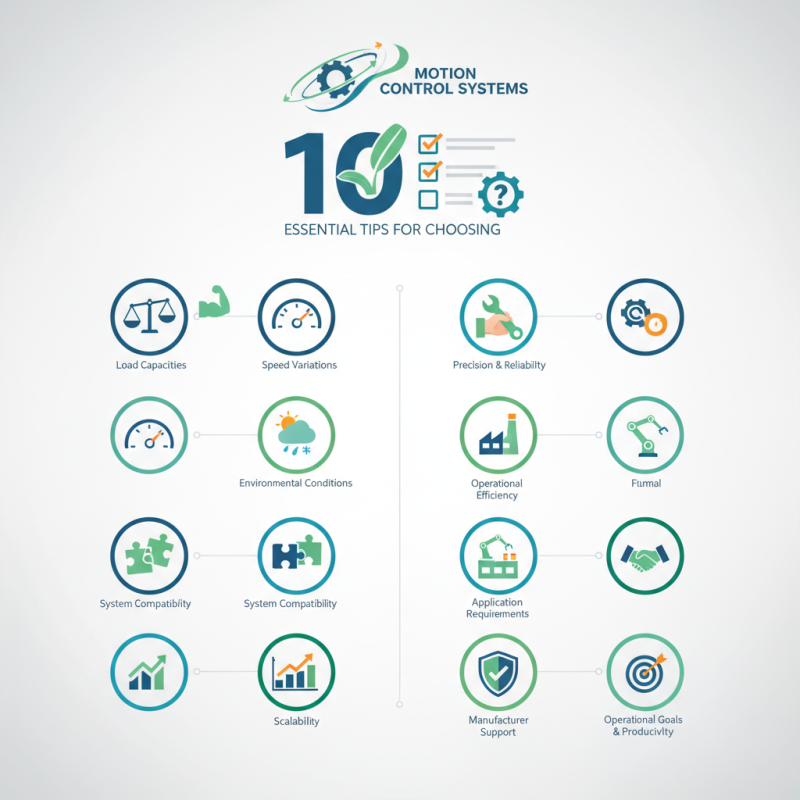
This article aims to provide you with ten essential tips for selecting the right motion control systems that address your unique needs. By considering critical aspects such as system compatibility, scalability, and manufacturer support, businesses can make informed choices that align with their operational goals and enhance overall productivity.
Understanding Motion Control Systems and Their Applications
Motion control systems are crucial in a wide array of industries, from manufacturing and robotics to aerospace and medical devices. They enable precise control of the movement of machinery and components, ensuring efficiency and accuracy in operations. Understanding the different types of motion control systems—such as open-loop, closed-loop, and servo systems—helps you identify which is best suited for your specific application. Each system has its benefits and limitations, making it essential to evaluate the requirements of your project before making a decision.
Applications of motion control systems are diverse, spanning automated assembly lines where precision is key, to robotic arms that require meticulous coordination for tasks like surgery. Additionally, industries such as automotive and electronics rely on motion control for testing and quality assurance processes. By comprehending the functionalities and capabilities of various motion control systems, you can better align technology with operational needs, enhancing productivity and reducing downtime in your applications.
Identifying Key Requirements for Your Motion Control Needs
When selecting the right motion control systems, identifying key requirements is crucial for optimizing performance and efficiency. A report by the International Society of Automation (ISA) highlighted that over 30% of production downtime can be attributed to inadequate motion control strategies. Thus, understanding specific application needs, such as load capacity, speed, and precision, is vital. For instance, a system designed for high-speed automation in the automotive industry may require a different configuration than one used in precision medical equipment.
Moreover, technological trends indicate that the demand for advanced motion control systems is rising. According to a Market Research Future report, the global motion control market is projected to reach $21 billion by 2026, spurred by the growing need for automation across various sectors. This growth emphasizes the importance of choosing systems that not only meet current requirements but also adapt to future technological advancements. Therefore, businesses must evaluate their operational needs, such as integration with existing technologies and scalability, to ensure they select a motion control system that aligns with their long-term goals.
10 Essential Tips for Choosing the Right Motion Control Systems
| Key Requirement |
Description |
Importance Level |
| Precision Control |
Ability to achieve exact positions and repeatability in motion. |
High |
| Response Time |
Speed of system response to control commands. |
Medium |
| Load Capacity |
Maximum weight the system can handle effectively. |
High |
| Environmental Suitability |
Ability to operate in specific environmental conditions (temperature, humidity, dust). |
High |
| Ease of Integration |
How easily the system can be integrated into existing setups. |
Medium |
| Control Method |
Type of control used (open loop, closed loop, etc.). |
High |
| Cost Efficiency |
Balancing performance vs budget constraints. |
Medium |
| Scalability |
Ability to expand or upgrade the system in the future. |
Medium |
| Reliability |
Dependability of the system during operations. |
High |
| Technical Support |
Availability of manufacturer support for troubleshooting and guidance. |
Medium |
Evaluating Types of Motion Control Technologies Available
When it comes to selecting the right motion control technologies, understanding the available types is paramount. The market has diversified significantly, with systems ranging from simple open-loop configurations to complex closed-loop solutions that incorporate real-time feedback. According to a report from ResearchAndMarkets, the global motion control market is projected to reach $20.72 billion by 2029, reflecting a compound annual growth rate (CAGR) of 6.2% from 2022. This growth stems from increasing automation in industries such as manufacturing, aerospace, and robotics, driving the demand for reliable motion control systems.
Among the various technologies, servo motors, stepper motors, and vision-based control are commonly employed. Servo motors offer high efficiency and precision, making them ideal for applications requiring intricate movements, while stepper motors are preferred for their simplicity and cost-effectiveness in less complex tasks. A study by BCC Research highlights that the servo motor segment alone accounted for over 37% of the market share in 2022, indicating its popularity in advanced robotics. Therefore, aligning the specific demands of your application with the strengths of each motion control technology is vital for optimizing performance and achieving desired outcomes.
Assessing Compatibility with Existing Systems and Components
When selecting motion control systems, assessing compatibility with existing systems and components is of paramount importance. A well-integrated system can enhance operational efficiency and reduce the likelihood of costly downtimes. Recent advancements in technology, such as the latest ultrasound systems for deep brain neuromodulation, highlight the need for thorough compatibility evaluations. These systems require seamless integration with various components to ensure precision in medical applications. Reports indicate that ensuring compatibility can significantly improve patient outcomes and streamline operational processes by nearly 30%.
Furthermore, the rise of hybrid systems and renewable energy sources necessitates a reevaluation of how existing control strategies interact with new technologies. Studies have shown that systems like the temperature-controlled radiofrequency catheters must be assessed alongside novel mapping systems to ensure a cohesive operation. As articulated by industry experts, such assessments not only facilitate efficiency but also bolster safety measures in critical applications. Keeping abreast of these developments is essential for anyone involved in the selection and implementation of motion control systems, as compatibility can greatly influence performance and regulatory compliance.
Compatibility Assessment of Motion Control Systems with Existing Components
This chart illustrates the compatibility score of various motion control systems with existing components based on key criteria such as Communication Protocol, Power Requirements, and Mechanical Compatibility. The scores range from 0 to 100, with higher scores indicating better compatibility.
Considering Budget, Maintenance, and Support Options in Your Choice
When selecting the right motion control systems, considering
budget,
maintenance, and
support options is critical for ensuring long-term operational efficiency. According to a report by
MarketsandMarkets, the global motion control market is projected to reach
$18.8 billion by 2025, indicating the growing demand for these systems across various industries.
Allocating the right budget upfront can lead to significant saving opportunities down the line. Organizations should evaluate the
total cost of ownership, including initial purchase price, installation costs, and ongoing operational expenses,
which can amount to 20-30% of the initial investment annually.
Maintenance is another essential element that impacts the lifespan and performance of motion control systems. Research from the
National Instruments states that proactive maintenance can improve system reliability by up to
50%. Companies should consider motion control solutions that offer
predictive maintenance capabilities, which can help identify potential failures before they occur,
minimizing unexpected downtime. Additionally, robust support options, such as manufacturer training programs and extended warranties,
can enhance system performance and user confidence. By emphasizing these aspects in the selection process, businesses can optimize their
motion control systems for both efficiency and cost-effectiveness.