Why Choose a Linear Motor Controller for Your Application?
When selecting a drive system for your application, it's crucial to consider the advantages of a linear motor controller. These controllers provide precise control over motion, making them ideal for various industries. Linear motors offer direct drive capabilities, which means fewer moving parts and less maintenance. This aspect is essential for improving reliability and performance.
Choosing a linear motor controller ensures higher efficiency in operation. These systems often consume less energy, leading to cost savings. The ability to implement real-time feedback makes them appealing for applications that require high precision. However, potential users should reflect on the complexities involved in their implementation.
Despite the clear benefits, not every application may suit a linear motor controller. Some systems may require different solutions based on performance needs or budget constraints. Careful evaluation of your specific situation is vital before making this choice.
Understanding Linear Motor Controllers and Their Functionality
Linear motor controllers play a crucial role in motion control applications. These controllers precisely regulate the position and speed of linear motors. This technology is vital in sectors like robotics, manufacturing, and healthcare.
Linear motors operate on the principle of electromagnetic force. They convert electrical energy into linear motion efficiently. A linear motor controller adjusts the timing and current to ensure optimal performance. As a result, it enhances accuracy in tasks such as material handling or 3D printing. Using these controllers can significantly reduce cycle times in production lines.
Tip: Always consider the load requirements of your application. Overloading can cause performance issues. Additionally, ensure the mounting setup is stable. Instability leads to misalignment, affecting precision. Choosing a controller that matches your motor's specifications is essential for reliability.
Understanding the functionality of each component can improve overall system performance. Doing so can minimize unnecessary delays and failures. Experimentation with different settings may also yield better results. Note that every application is unique; what works for one may not suit another.
Advantages of Using Linear Motor Controllers in Industrial Applications
Linear motor controllers offer distinct advantages in industrial applications. Their ability to provide precise control and high responsiveness is vital in automated environments. These controllers eliminate friction found in traditional gear systems. This reduces wear and improves efficiency.
Accuracy is another significant benefit. Linear motors can achieve positioning accuracy within microns. This precision is crucial for tasks that require tight tolerances. In industries like robotics, automotive, and packaging, small errors can lead to substantial losses. Linear motor controllers enhance the reliability of these processes.
However, there are challenges to consider. The initial cost of implementation can be higher than conventional motors. Maintenance may also require specialized knowledge. Understanding these aspects is essential for making informed decisions. Balancing the investment with long-term gains is key. Evaluating performance against specific application needs will ensure better outcomes.
Why Choose a Linear Motor Controller for Your Application? - Advantages of Using Linear Motor Controllers in Industrial Applications
| Advantages |
Description |
Applications |
| High Precision |
Linear motor controllers provide high positional accuracy, making them ideal for applications requiring precise movement. |
Robotics, CNC machining |
| Fast Response Time |
They offer rapid acceleration and deceleration, reducing cycle time and increasing productivity. |
Packaging machines, assembly lines |
| Reduced Maintenance |
With fewer moving parts than traditional motors, linear motors require less maintenance and have a longer lifespan. |
Material handling, conveyor systems |
| Energy Efficiency |
Linear motor controllers are designed to operate with minimal energy loss, saving on operational costs. |
Automated guided vehicles, HVAC systems |
| Compact Design |
Their sleek design allows for integration into space-constrained environments without sacrificing performance. |
Laboratories, semiconductor manufacturing |
Comparing Linear Motor Controllers with Traditional Motor Control Solutions
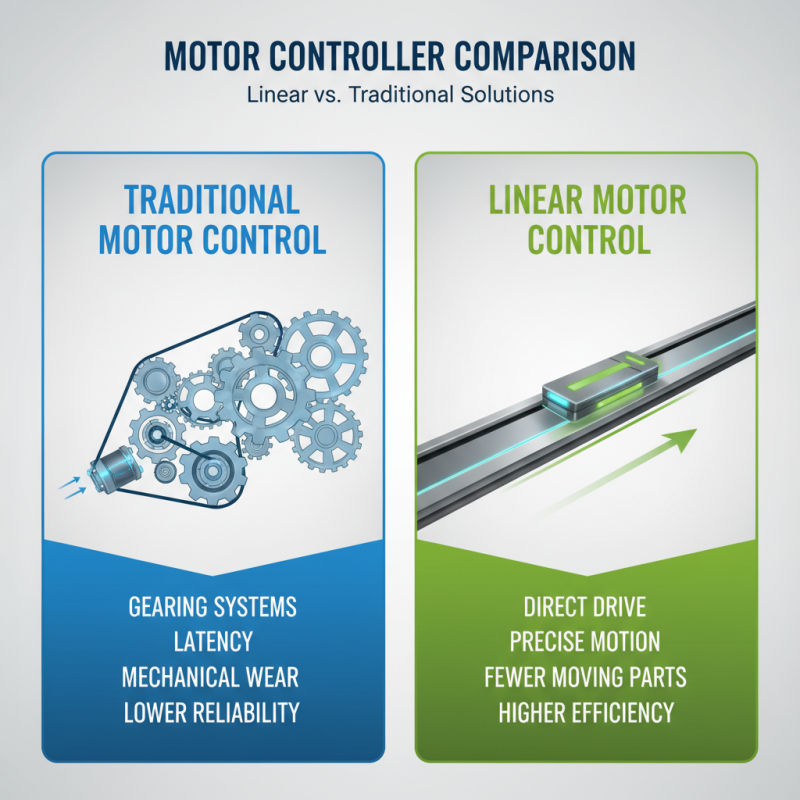
When comparing linear motor controllers with traditional motor control solutions, several key factors come into play. Traditional controllers often rely on complex gearing systems. This can introduce latency and mechanical wear. Linear motor controllers, however, operate directly to provide precise and immediate motion control. The design reduces the number of moving parts, enhancing reliability and overall efficiency.
Tips: Consider your application’s specific needs. If speed and precision are critical, linear motor controllers may be the best choice. Look for setups that minimize unnecessary components. Reliability can often stem from simplicity in design.
Another consideration is the ease of integration. Traditional systems may require extensive modifications to existing setups. Linear motor controllers typically offer more flexibility for upgrades or new implementations. They adapt easily to various applications, allowing for a quicker transition to modern technologies.
Tips: Don’t overlook compatibility with your current systems. Ensure that any new controller can be seamlessly integrated to avoid costly downtimes. A well-planned transition can save time and resources in the long run.
Factors to Consider When Choosing a Linear Motor Controller
When selecting a linear motor controller, there are several critical factors to evaluate. An important consideration is the required precision for your application. According to a report by MarketsandMarkets, the demand for high-precision applications in automation is expected to grow by 6% annually. Choosing a controller that meets this growing need can enhance performance significantly.
Another factor is the speed and acceleration capabilities of the controller. For instance, applications in robotics require rapid response times. Data indicates that linear motors can achieve acceleration rates as high as 50 m/s². However, not all controllers can effectively manage such dynamics. You'll want to ensure that the controller you select can handle the specific demands of your project.
Additionally, compatibility with existing systems cannot be ignored. Integrating a new controller into an established setup may pose challenges. Reports show that up to 30% of control-related implementation projects face compatibility issues. Recognizing and addressing potential integration hurdles early on is essential to avoid costly delays and maximize productivity.
Comparison of Linear Motor Controller Features
This chart displays the comparison of various features of linear motor controllers, assessing their performance in precision, speed, control complexity, cost, and efficiency. High values indicate superior performance in these dimensions, which are essential factors to consider when choosing a linear motor controller for your application.
Real-World Applications of Linear Motor Controllers in Automation
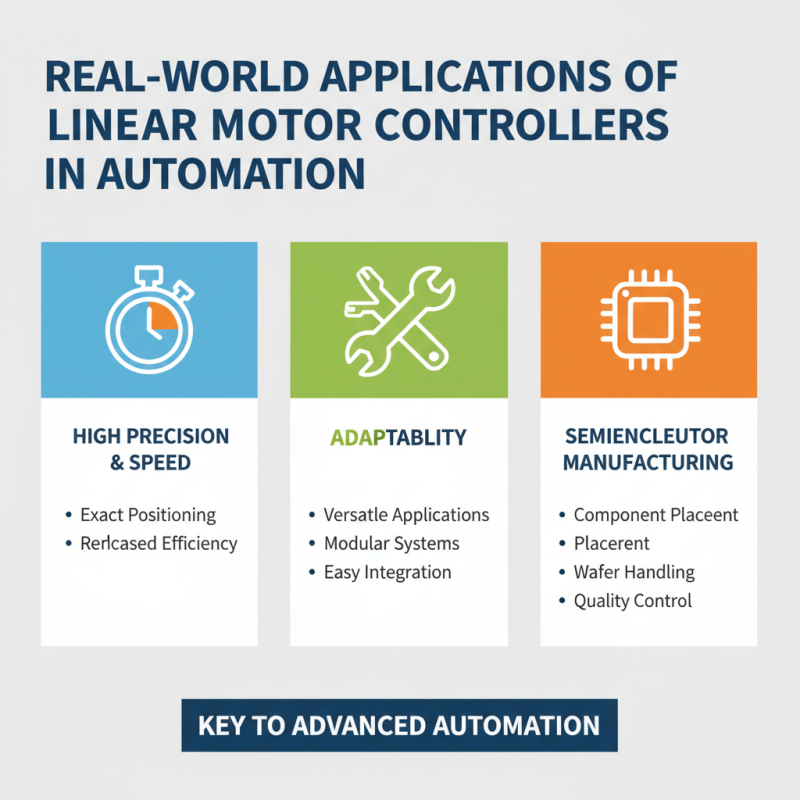
Linear motor controllers are pivotal in automation. They offer high precision, speed, and adaptability across various applications. For instance, in semiconductor manufacturing, these controllers enable exact positioning of components. This precision reduces defects and increases production efficiency.
In material handling, linear motor controllers enhance the speed of movement. Conveyors and automated guided vehicles benefit from their quick response times. However, integrating these controllers requires a clear understanding of system dynamics. Engineers must evaluate the specific needs of each application. This can be a complex process, as each environment demands a unique approach to control strategies.
Medical devices also leverage linear motor technology. They provide the necessary accuracy for critical procedures. Yet, the design of such systems poses challenges. Engineers must address safety and reliability, ensuring consistent performance. Balancing innovation with these safety considerations is essential.